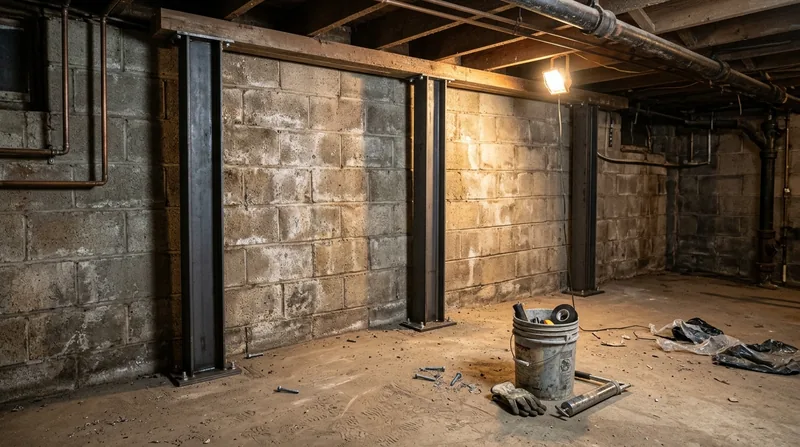




Bowing wall repair in Cedar Rapids starts with reading the ground, not the wall. In neighborhoods like Czech Village and Wellington Heights, 1890s to 1930s brick and frame homes sit on fieldstone or early block foundations, and the clay-rich glacial till behind them swells hard through spring thaw. Across Kingston Village and the east side, 1940s to 1960s bungalows and Cape Cods were built into the slope with full basements, so one wall often carries more wet soil than the other three. Add deep freeze-thaw cycles and April and June downpours, and the pressure builds sideways until a wall starts to lean inward. We use carbon fiber straps, steel I-beams, or wall anchors to stop that movement and stabilize the wall, matched to how far it has gone and what your soil is doing. If you are seeing a bulge, a horizontal crack, or a wall pulling away at the top, start with a free basement inspection before the next wet season.
Why Bowing Walls Show Up So Often in Cedar Rapids Basements
The failure mode here is hydrostatic pressure from wet clay, not a bad batch of block. When the water table climbs with snowmelt and heavy spring rain, saturated glacial clay pushes against the outside of a basement wall with enormous force. Older block and fieldstone walls were never engineered for that load, and they bow inward along the middle of the span. We see it most on the river side of town, where the soil holds water well into May.
- A horizontal crack near mid-wall usually means the wall is being pushed, not settling.
- Stair-step cracking in block follows the mortar joints as the wall rotates inward.
- Efflorescence and white powder on the inside face show water is moving through the wall.
- Doors and windows that stick on one side of the basement often track with wall movement.
- Walls pulling away at the top plate point to a different load path than a mid-wall bulge.
Any one of these is worth a look before the next freeze-thaw cycle widens the crack. The earlier we strap or anchor a wall, the less movement we have to arrest.
Key info: A 1920s block wall in New Bohemia that bulges an inch over ten years is a different repair from a wall that moved an inch in one wet spring. We measure the rate of movement, not just the current offset, because that tells us whether straps alone will hold or whether anchors need to reach out into stable soil.
For the official word on what work needs a permit in this city, check the City of Cedar Rapids building department before any structural foundation repair begins.
How We Stabilize a Bowing Wall in Cedar Rapids, Step by Step
We do not guess at a repair from the driveway. The first step is establishing how far the wall has moved and what is driving it, because a wall pushed by water needs the water handled as well as the wall braced. On poured walls in the newer north and west subdivisions, we often find the movement is minor and a strap system is enough. On old fieldstone in Wellington Heights, the wall itself may need a different anchor layout.
- We inspect the inside face, the top plate, and the floor line, and we check for efflorescence and fresh cracking.
- We measure the bow with a plumb line or laser and record the offset so we can compare it later.
- We check the outside grade, downspout discharge, and any window wells that are feeding water to the wall.
- We recommend carbon fiber straps for minor to moderate bowing on block or poured walls.
- We specify steel I-beams when the wall is badly bowed or the soil load is high.
- We install wall anchors when the wall needs to be pulled back and held from stable soil outside.
- We address the water source so the repair is not fighting the same pressure next spring.
Every repair ends with a written record of the starting offset so the next inspection has a baseline.
Key info: A ranch in Hiawatha had a rear wall bowing about 1.5 inches with a horizontal crack at mid-height. The downspouts dumped right at the corner and the grade sloped back to the house. We installed carbon fiber straps, extended the downspouts, and re-graded that corner. Two years later the wall had not moved.
If the inspection shows the wall is wet as well as bowed, we coordinate the structural work with an interior drain tile system so the soil pressure and the water are handled together.
Matching the Repair to the Wall: Methods We Use
No single method fits every bowing wall. The right choice depends on wall material, how far it has moved, and how much wet clay is pressing on it. Here is how we sort the options on a Cedar Rapids basement.
| Approach | Description | Best for |
|---|---|---|
| Carbon fiber straps | Straps bonded vertically to the inside face and anchored top and bottom to stop further inward movement. | Minor to moderate bowing on block or poured walls with no active water problem. |
| Steel I-beams | Vertical steel beams set against the wall and tied into the floor and joists to resist heavy soil load. | Badly bowed walls, high clay pressure, or walls that need a hard stop. |
| Wall anchors | Plates on the inside connected through the wall to anchors buried in stable soil outside. | Walls that need to be pulled back over time and held from outside. |
| Crack injection plus bracing | Epoxy or polyurethane injection to close active cracks, combined with a strap or beam system. | Walls with both movement and water coming through the crack. |
We pick the method after we see the wall, and we tell you plainly when a simpler crack repair is all that is needed.
Bowing Wall Repair Cost in Cedar Rapids: What to Expect
Most homeowners want a number before they commit, and that is fair. Bowing wall repair starts from $600 for a focused repair such as crack injection combined with a small strap layout, and rises with the length of wall involved, the method chosen, and how much prep the site needs. A full wall of carbon fiber straps on a long basement wall sits well above that starting point, and anchor systems that require outside excavation are a larger project again.
Several things move the price. The wall material matters, because fieldstone and old block take more prep than poured concrete. Access matters, because a wall behind a finished basement or a tight side yard takes longer. The rate of movement matters too, since a wall that is moving fast may need anchors rather than straps. Getting two or three estimates is smart, and it lets you compare the method each contractor proposes, not just the total.
Our full pricing overview breaks down the ranges by method so you can see where your wall likely falls before we visit.
What to Look For When Hiring a Bowing Wall Repair Contractor Near Me in Cedar Rapids
Bowing wall repair is structural work, so the contractor you hire should be able to explain why a method fits your wall, not just quote a price. Ask for proof of licensing and insurance, and ask whether the crew doing the work is the same crew that inspected the wall. A written scope that names the method, the materials, and the starting offset is a good sign. So is a contractor who tells you when the movement is minor enough to monitor rather than repair.
- Confirm the company is licensed and insured and can provide a certificate on request.
- Get two or three estimates and compare the method proposed, not only the total.
- Ask for references from jobs in Cedar Rapids or Marion with similar wall types.
- Ask who pulls the permit, since structural foundation repair commonly requires one.
- Ask how they will handle the water source, because bracing a wet wall is only half the job.
When you are ready to talk through your wall, contact us and we will set up a free inspection.
Bowing Wall Repair in Cedar Rapids: Pricing Guide
| Service | Price | Details |
|---|---|---|
| Crack injection with light bracing | Starting at $600 | Covers active crack injection plus a small strap layout; wall length and access move the price. |
| Carbon fiber strap system | Starting at $1,800 | Straps bonded and anchored along the bowed span; number of straps and wall height drive cost. |
| Steel I-beam stabilization | On estimate | Heavy soil load or severe bowing needs an on-site look to size beams and tie-ins. |
| Wall anchor system | On estimate | Outside excavation and anchor depth depend on soil and access, so we quote after inspection. |
| Travel | Included | In Cedar Rapids and surrounding areas, no separate call-out or mileage fee. |
| Estimate | Free | Response within 24h at (319) 304-3845, no obligation to book. |
Indicative pricing, the exact cost depends on square footage, finish, and site access. Free personalized estimate within 24h at (319) 304-3845.


